
Step Inside the Orchestra: Philharmonia Launches Immersive VR Experience for Young Audiences
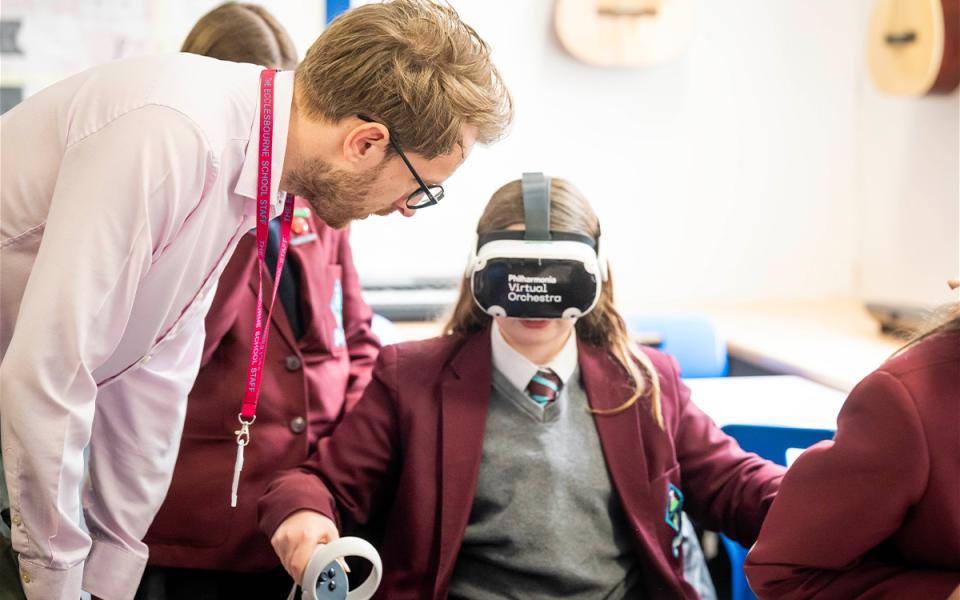
Audiences are invited to step inside one of the world’s leading orchestras on 27 & 28 May at the launch of a new immersive virtual reality experience. Building on over 15 years of innovation in digital experiences, and supported by Innovate UK, the Philharmonia Orchestra’s Virtual Orchestra: William Tell puts participants at the heart of the orchestra as they perform Rossini’s exhilarating overture.
Designed with children and young people at its core, the experience allows users to pick up a virtual instrument, learn through guided tutorials, and perform as part of the orchestra. Participants can choose percussion instruments including cymbals, timpani and triangle, building skills before joining a full orchestral performance in a packed concert hall setting.
The project marks the next stage in the Philharmonia’s long-standing work in digital innovation, aiming to break down barriers between audiences and performers and open up new ways of engaging with classical music.
Marta Génova, the Philharmonia Orchestra’s Head of Digital Product and Experience, says, “For over a decade, the Philharmonia Orchestra has pioneered immersive musical experiences, and Virtual Orchestra: William Tell takes that work into a new phase where we ask audiences to participate rather than observe. For the first time in our VR work, users can take up a virtual instrument, develop skills through guided practice, and perform with the orchestra onstage, among the musicians, in concert.
“Through R&D collaboration with percussionist Tom Edwards, Meta Camera and Schallgeber, we have developed new ways to connect artists and audiences, reducing barriers to engagement and making cultural spaces more welcoming to participants.”
Filmed at the Royal Festival Hall in April 2025 and conducted by Principal Conductor Santtu-Matias Rouvali, the experience introduces audiences to the orchestra through player-led tutorials before placing them at the centre of a live performance. Wearing VR headsets, participants begin in a virtual rehearsal studio, learning core musical skills, before stepping onto the stage of a packed concert hall to join the percussion section.
Guidance and encouragement come from British musician and producer Love Ssega (former co-founder of Clean Bandit and Philharmonia Artist in Residence 2022/23), who leads users through the experience and reveals their final score at the end of the piece.
Participants can choose from cymbals, timpani or triangle, developing their skills while learning how each instrument contributes to the orchestra. Coaching is provided by Philharmonia percussionist Tom Edwards.
Tom Edwards says, “It’s really exciting to be involved in this groundbreaking new project, embracing state of the art technology to give children a truly unique and fun educational experience, and a rare opportunity for us to place them in the very centre of the Philharmonia Orchestra in action. Music education has so many benefits for young children and this VR platform is a hugely valuable learning tool, allowing them to engage with and take part in the orchestra in an entirely new, exciting and immersive way.”
The live performance in the experience was filmed using an array of the acclaimed Meta series of 3D 360 cameras, for ultra-high 12.5k resolution and cinematic quality. Live audio was recorded and mixed using object-based spatial audio techniques and converted to higher-order Ambisonics, to render the full acoustic depth and geometry of the performance space. Every instrument occupies its true position in three-dimensional space, captured at the highest spatial resolution currently possible.
Aligned with the aims of the Association of British Orchestra’s An Orchestra in Every School campaign, the Virtual Orchestra reimagines how orchestral music is introduced to young people. Alongside the VR experience, the Philharmonia has developed a curriculum-linked programme for Key Stage 3, with resources and CPD support for teachers. The project responds to growing concerns around declining music participation in schools, with GCSE Music entries falling significantly in recent years.
Teddy Prout, Director of Learning and Orchestral Operations for the Philharmonia says, “As frontrunners in the use of innovation and technology in classical music, I am delighted that we have been able to create this monumental educational product that will change the landscape of music education for young people. To create an interactive, engaging way of getting to know the orchestra, enhance methods of learning practical musical skills, and showcase the artistic brilliance of our musicians, brings together the core values and goals of the Philharmonia. We are hugely grateful and honoured to have received funding from DCMS to produce Virtual Orchestra: William Tell, and I can’t wait to see this rolled out in schools across the country.”
The Philharmonia Orchestra was among 272 recipients to benefit from the Innovate UK/ DCMS Create Growth Programme in 2025. The £99,284 grant enabled R&D and the pilot programme with a Year Seven cohort from 13 schools from Leicestershire, Derbyshire and Lincolnshire. The Philharmonia Orchestra is grateful for additional support of the project by the David and Elaine Potter Foundation.
The experience will take place at Southbank Centre on 27 and 28 May with sessions from 11am to 3pm on the 27th, and 11am to 5pm on the 28th. More details available here.
For more information or to enquire about press access, please contact Natasha Mallett (natasha.mallett@philharmonia.co.uk)