
Backstage Pass: Cristian Măcelaru
Ahead of his concerts with the Philharmonia, Cristian Măcelaru shares his thoughts on the similarities between Elgar and his French contemporaries, rediscovering music by female composers, and working with Nicola Benedetti.
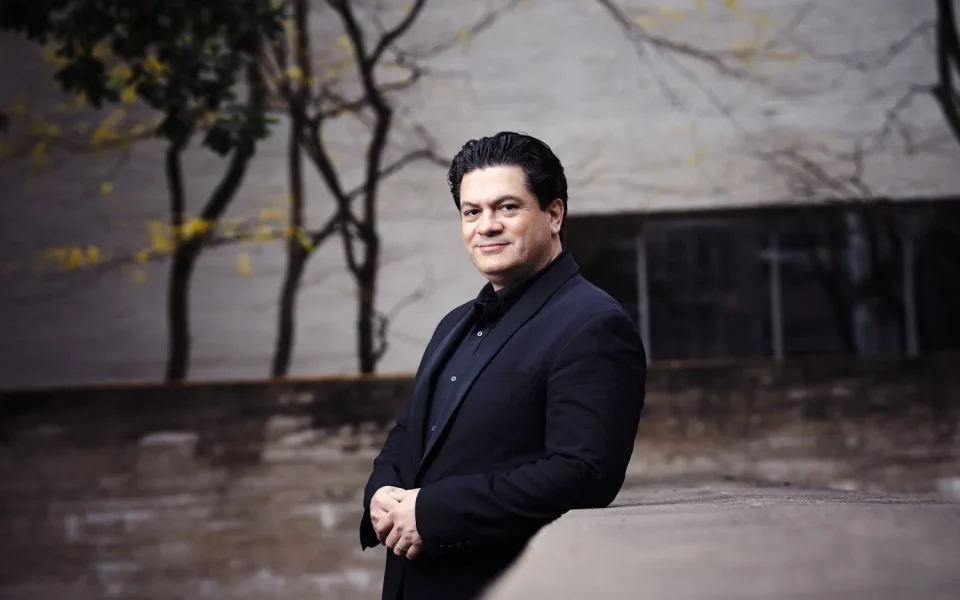
Could you speak a little about the programme? British audiences often think of Elgar as a very English composer; what might we hear differently by pairing his music with Chaminade and Debussy?
I have always thought that Elgar’s music is best heard in a context of his French contemporaries. It highlights the profound depth found in the harmonic language as well as Elgar’s melodic lines. In contrast to the transparency required by the French composers, Elgar’s music brings forth the noble and elegant approach needed to truly appreciate this genius composer.
Chaminade’s music has been unfairly neglected. How did you discover her music, and how important is it to perform music by women composers who have been unfairly forgotten?
Chaminade used to be a composer discovered only in music history textbooks but with little representation on stage today. A musician from my orchestra in Paris encouraged me to look at Callirhoë and when I did, I discovered a forgotten gem! I place great importance on re-discovering music by women composers especially from the 19th and early 20th centuries, to show that we have had remarkable women composers writing music all throughout history, and that this is not a modern invention.
How are you looking forward to collaborating with Nicola Benedetti?
I have collaborated closely with Nicola for a little more than a decade. We have learned to trust each other, and it is always such a joy to explore even more repertoire together. I know her Elgar concerto to be exquisite and cannot wait to share this with the audience.
It’s a pleasure to reunite in our 80th birthday season, and we look forward to working together again this Summer at the Grafenegg Festival. You conduct many orchestras around the world: what distinguishes the Philharmonia?
I have always had great respect for the Philharmonia. Not only through its wonderful recording legacy, but also hearing them in my home country at the Enescu Festival in Bucharest, where they are always appreciated and loved. Their concept of sound and homogenous breath is captivating. Every time we work together I discover even more of their committed intensity on stage, and deep respect for the music that binds us together.
A conductor’s life is busy and international. How do you relax away from the podium?
I am a great lover of nature and in between rehearsals, in between concerts one can often f ind me walking in the nearest park. The quiet joy of being in nature truly fuels my soul.
I place great importance on re-discovering music by women composers […] to show that we have had remarkable women composers writing music all throughout history, and that this is not a modern invention.

Nicola Benedetti plays Elgar
Nicola Benedetti joins Cristian Măcelaru in Basingstoke and London for Elgar’s emotional and virtuosic Violin Concerto.
Read more